What Is TIG Welding? Process Basics Explained
Disclosure: This post contains affiliate links. As an Amazon Associate, I earn from qualifying purchases—at no extra cost to you.
Last Updated: January 2026
TIG welding is a welding process known for precision, control, and clean weld appearance. It is commonly used in applications where weld quality, aesthetics, and material control matter more than speed.
Based on manufacturer specifications, aggregated user feedback, and guidance from the American Welding Society (AWS), TIG welding is best understood as a manual arc welding process designed for accuracy, low spatter, and excellent control over heat input.
This guide explains what TIG welding is, how the process works, and where it is most commonly used.
👉 If you are deciding which welding process fits your needs overall, see best welding machines for a broader comparison.
📋 How We Evaluate Welding Processes
This research-based guide draws from:
- Manufacturer technical specifications
- Aggregated user feedback from verified purchasers
- Industry standards from organizations such as the American Welding Society (AWS)
- Application-specific requirements for common welding processes
We do not personally test equipment. All information reflects documented specifications, industry standards, and commonly reported use patterns.
🔍 What TIG Welding Means
TIG stands for Tungsten Inert Gas, and the process is formally classified by AWS as Gas Tungsten Arc Welding (GTAW).
According to AWS definitions:
- A non-consumable tungsten electrode is used to create the arc
- Filler metal is added manually, if required
- Shielding gas protects the weld pool from atmospheric contamination
Because the tungsten electrode does not melt into the weld, TIG welding offers exceptional control over weld size and heat input.
🔍 How the TIG Welding Process Works
Manufacturer documentation and AWS guidance describe the TIG welding process as follows:
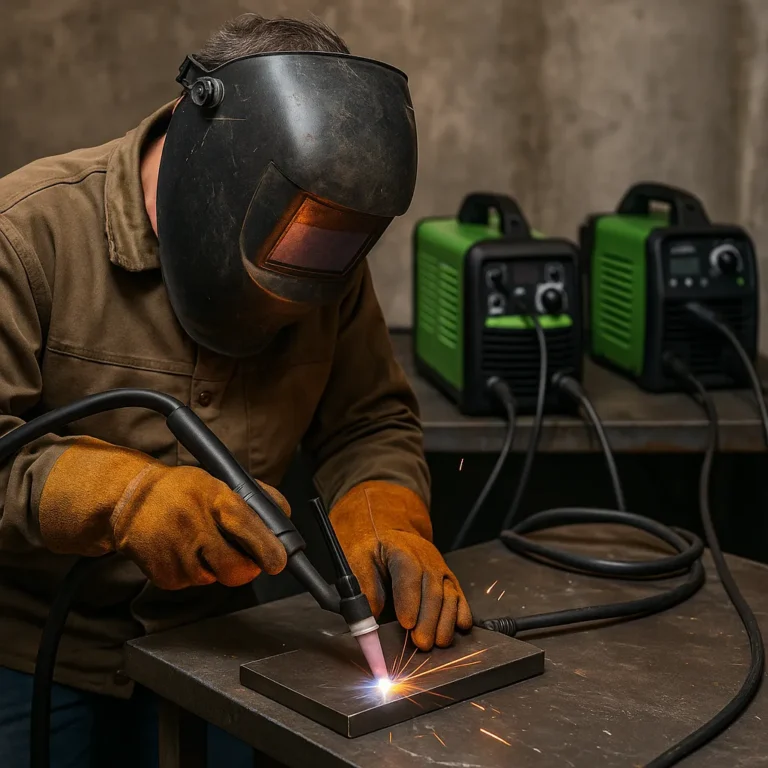
- The arc forms between a tungsten electrode and the base metal
- Shielding gas flows continuously to protect the arc and molten weld pool
- Filler rod is fed by hand into the weld pool as needed
- Amperage is often controlled with a foot pedal or torch-mounted control
This high level of manual control is what makes TIG welding suitable for thin materials and detailed work.
🔍 Materials Commonly Welded With TIG
TIG welding is compatible with a wide range of metals.
According to manufacturer specifications and AWS references, TIG welding is commonly used on:
- Aluminum
- Stainless steel
- Mild steel
- Magnesium, copper, and other specialty alloys
Its ability to control heat precisely makes TIG welding especially valuable for thin or heat-sensitive materials.
🔍 AC vs DC TIG Welding
TIG welding can operate in different current modes depending on the material.
Based on AWS standards and manufacturer documentation:
- DC TIG welding is typically used for steel, stainless steel, and chromoly
- AC TIG welding is required for aluminum and magnesium due to oxide layer removal
Machines that support both AC and DC TIG offer broader material compatibility.
🔍 Where TIG Welding Is Commonly Used
AWS-aligned guidance and aggregated user feedback show TIG welding is frequently used in:
- Precision fabrication and custom metalwork
- Automotive and motorsports applications
- Aerospace and aviation components
- Food-grade and sanitary stainless steel work
TIG welding is often selected where appearance, strength, and consistency are critical.
🔍 Limitations of TIG Welding
TIG welding is not always the most efficient choice.
According to AWS standards and documented use patterns, limitations include:
- Slower welding speed compared to MIG welding
- Steeper learning curve due to manual coordination
- Less suitability for dirty or rusty materials
- Reduced efficiency for thick structural welding
Understanding these limitations helps determine when MIG or stick welding may be more appropriate.
📌 Key Takeaways
- TIG welding is formally known as Gas Tungsten Arc Welding (GTAW)
- Uses a non-consumable tungsten electrode and shielding gas
- Provides exceptional control and clean weld appearance
- Commonly used on aluminum and stainless steel
- Prioritizes precision over speed
⚠️ Safety & Training Requirements
Welding involves significant electrical, fire, burn, and eye injury hazards. This guide provides general information only and does not substitute for:
- Proper welding training and certification
- Manufacturer safety instructions
- Electrical work performed by qualified electricians
- Appropriate personal protective equipment (PPE)
Consult certified welding instructors and follow all OSHA and AWS safety standards.
🟢 FAQs
Q: What does TIG stand for in welding?
According to AWS terminology, TIG stands for Tungsten Inert Gas, while the formal process name is Gas Tungsten Arc Welding (GTAW). Consult qualified professionals for personalized advice.
Q: Is TIG welding harder to learn than MIG welding?
AWS guidance and aggregated user feedback indicate TIG welding typically has a steeper learning curve due to manual filler control and heat management. Consult qualified professionals for personalized advice.
Q: Is TIG welding only used for aluminum?
No. TIG welding is commonly used for aluminum, stainless steel, mild steel, and specialty alloys according to manufacturer documentation and AWS standards. Consult qualified professionals for personalized advice.
✅ Conclusion
Based on manufacturer specifications, aggregated user feedback, and AWS-referenced standards, TIG welding is a precision-focused welding process valued for control, cleanliness, and material versatility. Understanding how TIG welding works and where it performs best helps determine whether it is the right process for a given application.