Welding Helmet Safety Standards: What Welders Need to Know to Stay Protected
Disclosure: This post contains affiliate links. As an Amazon Associate, I earn from qualifying purchases—at no extra cost to you.
Last Updated: January 2026
A welding helmet only protects you if it actually meets real safety standards. A shell can feel solid and still fall short if the lens, shade rating, or impact protection isn’t certified for welding use. That’s why welding helmet safety standards matter just as much as fit or features.
Whether you weld on weekends or spend full shifts under the hood, safety standards help ensure your eyes and face are protected from arc radiation, sparks, and impact. Knowing what those standards mean makes it easier to trust your gear and avoid unnecessary risks.
👉 If you’re comparing certified options, our guide to the best welding helmets breaks down safety ratings, comfort, and real-world use.
🔍 Why Welding Helmet Safety Standards Matter
Welding exposes your eyes to intense ultraviolet (UV) and infrared (IR) radiation. Even brief exposure without proper protection can lead to arc eye, headaches, and long-term vision damage.
Safety standards exist to make sure helmets consistently block harmful radiation, maintain the correct shade level, and hold up to impact. Helmets that meet recognized standards are tested for performance, not just how they look on the shelf.
🔍 Common Welding Helmet Safety Standards Explained
Different regions use different standards, but they all aim for the same result—reliable protection.
In the United States, ANSI Z87.1 is the most common standard. Helmets meeting this rating are tested for impact resistance and optical performance. In Europe, EN 175 focuses on helmet construction, while EN 379 applies to auto-darkening lens performance.
Auto-darkening lenses are also tested for switching speed, shade accuracy, and UV/IR protection, even when the lens is in its light state.
🔍 What to Look for on a Welding Helmet Label
Certified helmets clearly show their safety markings.
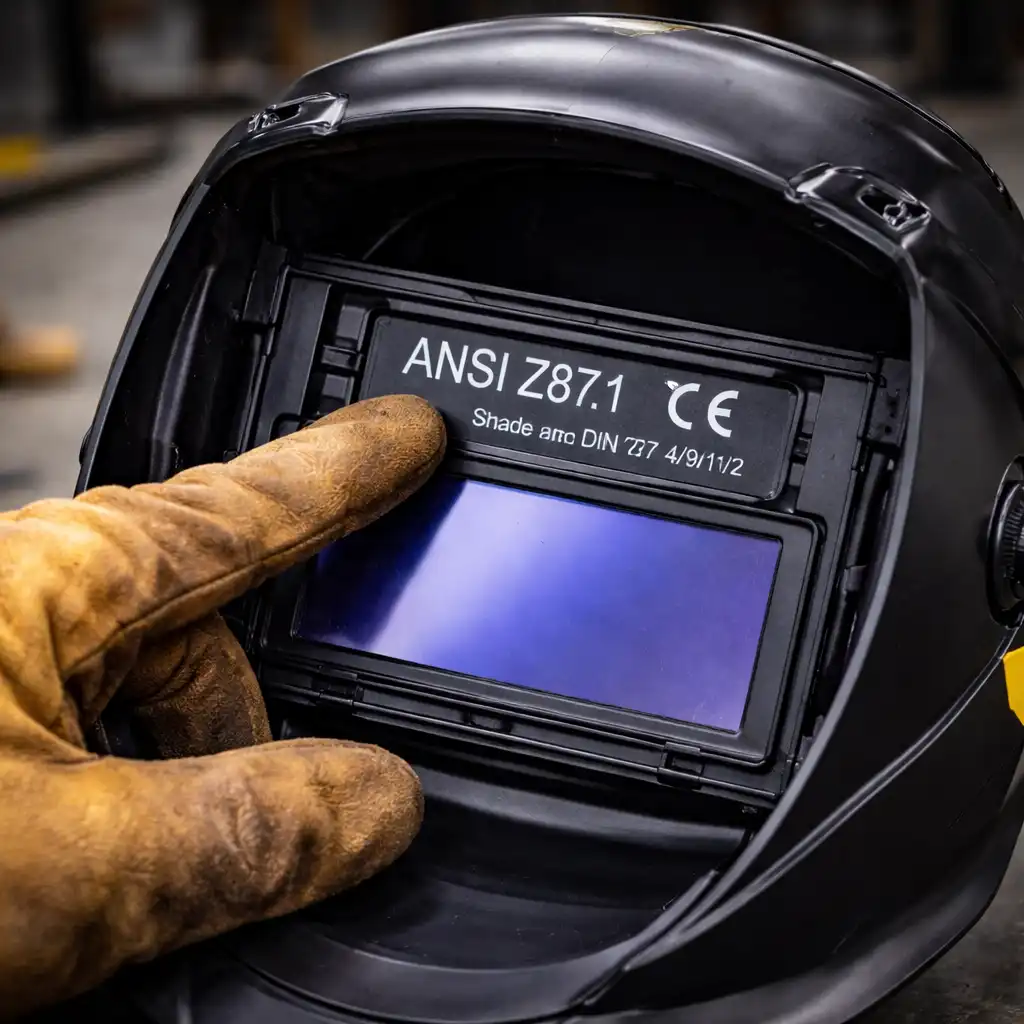
You’ll usually find them printed inside the helmet shell or directly on the lens. These markings list the applicable standard, shade range, and optical class for auto-darkening filters.
If a helmet or lens doesn’t show clear certification information, it’s a red flag that protection may not meet minimum safety requirements.
🔍 Passive vs Auto-Darkening Helmet Safety
Both passive and auto-darkening helmets can be safe when they meet the proper standards.
Passive helmets rely on a fixed-shade lens that always blocks harmful radiation. Auto-darkening helmets use electronic filters that darken when an arc is detected, but they still provide constant UV and IR protection.
The real safety factor isn’t the lens type—it’s certification and proper function.
🔍 When a Welding Helmet May No Longer Be Safe
Even a certified helmet can become unsafe over time.
Cracked shells, worn headgear, or damaged lenses can compromise protection. Auto-darkening lenses that flicker, react slowly, or fail to darken consistently should be addressed right away.
Regular inspections help catch these issues before they turn into real hazards.
📌 Key Takeaways
- Welding helmet safety standards protect your eyes and face from radiation and impact
- Certified helmets are tested for consistent, reliable protection
- ANSI and EN standards cover most modern welding helmets
- Clear labeling helps confirm proper certification
- Damaged helmets may no longer meet safety requirements
🟢 FAQs
Q: Are all welding helmets required to meet safety standards?
In professional environments, helmets must meet applicable safety standards. Even for home welding, certified helmets are strongly recommended.
Q: Does auto-darkening mean a helmet is safer?
Not automatically. Safety depends on certification and proper operation, not lens type alone.
Q: Can a helmet lose its safety rating over time?
Yes. Damage, wear, or faulty lenses can reduce protection even if the helmet was originally certified.
Q: Where can I find the safety rating on my helmet?
Check inside the helmet shell or on the lens for printed certification markings.
✅ Conclusion
Welding helmet safety standards exist to protect your vision and your face from serious harm. Understanding certifications, checking labels, and inspecting your helmet regularly makes it easier to weld with confidence. A safe helmet isn’t about bells and whistles—it’s about meeting proven standards every time you strike an arc.